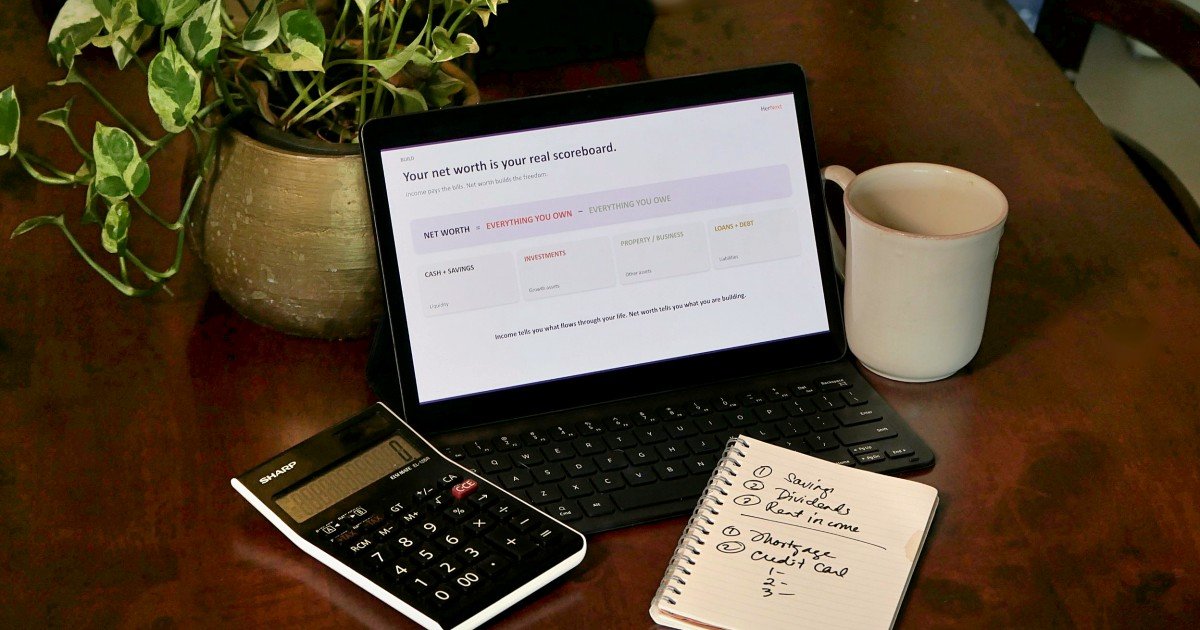
Learn how to calculate your net worth in 15 minutes. The figure matters more than your salary ever will.
When was the last time you actually calculated what you’re worth? Not your salary. Not your savings account balance. Your real number: everything you own, minus everything you owe.
If you can’t answer that off the top of your head, you’re in good company. I couldn’t either, for most of my adult life. I had a savings account, a couple of investments I’d bought on someone’s recommendation, no overdue bills. By every casual measure, I was “fine.” What I didn’t have was any real idea whether I was moving forward or just staying afloat.
That gap between feeling fine and actually knowing is what net worth fixes. Good news, it takes about 15 minutes to calculate, no finance background required. Here’s exactly how.
Why this number beats your salary
Your income tells you what’s flowing through your life. Your net worth tells you what you’re actually building with it. You can have a great income year and still not be building wealth, if it’s all going out the other side, and you’d never know it just by checking your payslip.
Net worth is the one number that can’t lie to you the way income can. It’s the honest scoreboard.
The formula (it’s simpler than it sounds)
Net worth = everything you own − everything you owe.
That’s it. No formulas to memorize, no finance degree required. Just two lists and one subtraction.
Step 1: List everything you own
Open a notes app, a spreadsheet, or literally a piece of paper, and total up:
- Cash and savings: checking accounts, savings accounts, cash under the mattress (be honest)
- Investments: mutual funds, UITFs, stocks, Pag-Ibig MP2, PERA, anything sitting in a brokerage or investment account
- Retirement-type accounts: SSS or GSIS contributions if you can estimate their value, any pension fund
- Property: your home’s current market value (not what you paid for it), any other real estate
- Business equity: if you own all or part of a business, a reasonable estimate of its value
- Other significant assets: your car, jewelry you’d actually sell if you had to, anything else worth a meaningful amount
Don’t overthink the exact valuations. Round numbers are fine. The goal is a realistic picture, not an audit.
Step 2: List everything you owe
Now the less fun list:
- Credit card balances: the full amount, not just the minimum due
- Personal loans
- Car loans
- Mortgage balance: what you still owe, not what the house is worth
- Any other debt: money borrowed from family counts too, if you’re actually planning to pay it back
Again: be honest. This list only helps you if it’s real.
Step 3: Subtract
Total assets minus total liabilities. That’s your net worth.
For most people, this is the part that stings a little the first time. Mine certainly did. Cash sitting in an account earning next to nothing. Insurance I’d meant to review three years earlier. Debt I’d stopped thinking about because the payments were automatic. None of it was a crisis on its own. All of it was quietly costing me, and I’d never once seen it laid out in one place.
Step 4: Do it again in six months
A single net worth number is a snapshot. It’s useful, but it’s not the real payoff. The real payoff is the trend, being able to watch that number move over quarters and years, the same way a business owner checks their books.
Twice a year is genuinely enough. You don’t need to obsess over it weekly, and you shouldn’t; markets and property values move around too much month to month for that to tell you anything useful. But twice a year, sit down, redo the two lists, and watch the direction.
That’s the whole practice. I’ve been doing this for five years now, and it’s the single habit that changed how I see money. You can’t manage what you’re not looking at.
One honest caveat
Your net worth number is not a report card on your worth as a person, and it’s not a competition with anyone else’s. Two people can have wildly different numbers because of wildly different starting points, and neither is doing anything wrong. What matters isn’t where you’re starting. It’s whether the number six months or a year from now is heading in a direction you’re comfortable with.
Your turn: block off 15 minutes this week. Two lists, one subtraction. You’ll probably feel exactly what I felt the first time: a little exposed, and a lot more in control.